Thursday, January 26, 2017

Sneak peek at February Uptown: Law enforcement training trends

By Sarita Chourey, Uptown editor/content manager 
Officers training at the Criminal Justice Academy (credit/Florence McCants)
Vetting new police recruits on the front end can do a lot to help departments move new hires through the S.C. Criminal Justice Academy. It’s also helpful to prepare recruits by putting them through a “pre-academy” program.

"The slots are so valuable that it behooves everyone to do due diligence to send the best possible candidate," said CJA Director Jackie Swindler. "It saddens me to see some candidates who come through who are not going to be successful." 

Find out what else Swindler recommends in this early look at what’s in store for the February issue of Uptown. The full issue will be online and in mailboxes next week.
 
Swindler will also be one of the speakers at Hometown Legislative Action Day, Wednesday, February 1, for a panel that will discuss law enforcement trends as well as proposals for CJA funding, which are part of the Municipal Association's 2017 Advocacy Initiatives. S.C. Department of Social Services Law Enforcement Liaison Larry McNeil and Ryan Alphin, executive director of the S.C. Law Enforcement Officers’ Association and the S.C. Police Chiefs Association, will also participate in the panel.

There’s additional information on this topic of recruiting and retaining police officers in this presentation by Todd Williams, public safety loss control consultant for the Municipal Association, at the recent meeting of the S.C. City/County Management Association.

Also read this Uptown article from 2016 that looks at lessons learned from other states to illustrate why it’s important to review recruitment policies and training practices to prevent similar occurrences.

Monday, January 23, 2017

FCC threatens to limit local land use authority on wireless siting

By Angelina Panettieri, Principal Associate for Technology and Communications, National League of Cities

Late last month, the Federal Communications Commission issued a public notice seeking comment on two topics that could shape the future of city control over their rights-of-way. 

The FCC's Wireless Bureau requested public comment on how to streamline the deployment of small wireless facilities, primarily through potential changes to local land-use ordinances, and comment generally on a petition filed by infrastructure company Mobilite regarding local government rules and procedures.

The public notice raises several major concerns for cities. The first is that the FCC wishes to use this proceeding to reexamine the facts of the decisions made in its 2009 and 2014 rulemakings on local wireless facilities siting, questioning whether the evidence presented by local governments during those proceedings is still valid.

Second, the notice questions the amount of time needed by local governments to process wireless siting applications for small-cell facilities, particularly when submitted in large quantities. The notice requests feedback on streamlining local regulations when similar applications are submitted as batches. 

Also, the notice questions the amount and structure of fees charged by local governments for applications and access to rights-of-way.

The National League of Cities successfully filed a joint motion for an extension of the comment period. The revised comment deadline is now March 8, 2017, with a reply comment deadline of April 7, 2017.
NLC will comment on this notice, in collaboration with other local government groups and state municipal leagues, and is calling on cities nationwide to help craft our response.  

Help NLC comment on this notice by providing important data on your city's wireless facility siting process by January 27 and to request a comment template for your city to use in providing your own comment.

Thursday, January 12, 2017

Hometown Legislative Action Day just around the corner

Listen to the City Quick Connect podcast featuring the Association's legislative team with more details about what's on tap for Hometown Legislative Action Day.

In less than three weeks, more than 500 local officials will travel to Columbia to meet with their legislators and learn about issues important to cities and towns. Hometown Legislative Action Day is February 1, and the deadline to register is January 18.

We will start the day with a conversation with five of the members of the House Tax Policy Review Committee that’s been meeting since last summer. Five committee members – Reps. Tommy Pope, Chandra Dillard, Todd Atwater, Mandy Powers Norrell and Joe Daning  - will bring their perspectives about the committee’s work. Lexington Mayor Steve MacDougall will facilitate this conversation. 

Committee members have heard from state tax experts, municipalities and counties, the business community and residents voicing their perspectives on taxes. The members have discussed eliminating certain sales tax exemptions, making changes to Act 388 and decreasing the state income tax. 

Next, two Senate leaders will bring their perspective on the 2017 session. Senator Shane Massey from Aiken County is the Majority Leader and Senator Luke Rankin is the new chairman of the Judiciary Committee.

We will also welcome the president of the National League of Cities, Clarence Anthony, who will help us sort out what’s going on in Washington with the new administration and new Congress.

During lunch, Secretary of Transportation Christy Hall will brief attendees on the status of the S.C. Department of Transportation and the outlook for road funding in the new legislative year.

HLAD speakers will also address law enforcement trends and proposals. Serving on the panel are Criminal Justice Academy Director Jackie Swindler, S.C. Department of Social Services Law Enforcement Liaison Larry McNeil and Ryan Alphin, executive director of the S.C. Law Enforcement Officers’ Association and the S.C. Police Chiefs Association.

A representative from the Public Employee Benefit Authority will update attendees on challenges in the State Retirement System. Plus attendees will get a briefing on how to complete their 2016 Statement of Economic Interests based on the new requirements on income disclosure passed last year.

We will wrap up the day with a Taste of South Carolina legislative reception celebrating local foods and craft beers. 

Before coming to Columbia, connect with colleagues and get up-to-the-minute meeting information on your Android or Apple smartphones and tablets. Download the mobile HLAD app by searching for MuniAssnSC in the App Store or Google Play, or view the web version of the app.

Listen to the City Quick Connect podcast featuring the Association's legislative team with more details about what's on tap for Hometown Legislative Action Day.

Friday, January 6, 2017

Tips for a mindful new year

By Meredith Kaiser, loss control consultant for the SC Municipal Insurance Insurance Trust and SC Municipal Insurance Risk and Financing Fund

It’s the start of a new year and resolutions abound. How many among us have said, “I need to be more present in my life, pay more attention to what I’m doing, be more mindful of what’s happening around me.”

Growing evidence shows that mindfulness, which is defined by Dr. Jon Kabat-Zinn as “paying attention in a particular way moment to moment without judgement or reactivity,” improves stress levels, back pain, cognitive function and even changes the structure of the brain.

Zinn, who has a Ph.D. in molecular biology from MIT, founded the MBSR program, or mindfulness based stress reduction program, an 8-week class offered in more than 720 medical facilities around the world.

He developed MBSR to help patients, who often became depressed or developed maladaptive responses, to deal with chronic illness, pain or other medical challenges. Maladaptive responses include overuse of medications or alcohol. Zinn’s recently updated book, Full Catastrophe Living: Using the Wisdom of Your Body and Mind to Face Stress, Pain, and Illness includes much of the new research findings on the positive effects of mindfulness.

I took my first MBSR class in 2012. I felt it paralleled the safety concept of root cause analysis. The source of many human performance failures, such as workplace injuries, involve conditions which can be improved through mindfulness practice. One such condition is poor quality sleep.

David Gelles’ book, Mindful Work: How Meditation is Changing Business from the Inside Out, follows the history of the mindfulness in the United States and its impact on workplaces like Ford, General Mills, Google and Patagonia. Mental health programs, professional sports teams, schools, the U.S. military and police agencies are also seeing positive results.

The Oregon cities of Bend and Hillsboro offer mindfulness programs in their police departments. Lt. Richard Goerling of the Hillsboro police department spearheaded these programs by tailoring the MBSR program to first responders. He and a co-trainer now offer a three day Mindfulness Based Resilience Training program twice a year open to first responders from across the country, as well as other trainings. 

Recent studies of law enforcement officers have shown reductions in alcohol use, anger, aggression, and stress, as well as improvements in empathy and sleep.

Mindfulness training for West Columbia public works, parks and recreation, and maintenance departments
In 2016, the Association's Risk Management Services began offering onsite one-hour mindfulness classes for member cities in the SCMIT and SCMIRF programs. To date more than 200 employees in four cities have attended. 

Thursday, December 8, 2016

Focus on law enforcement advocacy initiatives

By Tigerron Wells, Government Affairs Liaison

Continuing our weekly City Connect review of the Municipal Association’s 2017 Advocacy Initiatives, I’m pleased to provide you with some background about two of our initiatives related to law enforcement in South Carolina.

Support reliable funding for the Criminal Justice Academy to provide improved training opportunities for law enforcement officers 

The Criminal Justice Academy provides basic training and certification for almost every law enforcement officer in the state. However, the Academy’s funding is dependent almost exclusively on revenue collected from state and local fines and fees.
CJA Director Jackie Swindler briefs mayors about training requirements and funding challenges
During a recent meeting of the Association of South Carolina Mayors held at the SC Criminal Justice Academy, mayors heard from the recently appointed CJA Director Jackie Swindler, former police chief in Newberry, about this funding challenge. He also discussed the importance of hiring good officer candidates and complying with requirements for timely officer registration with the Academy and firearms training within the days following hire.

Swindler talked with the mayors about the process for police departments to get new recruits into the Academy noting that the average wait time is 52 days from the date an officer is registered. This time can be significantly shorter if the department requests the officer be added to a waiting list at the time of registration.

The mayors got a chance to walk the Academy grounds and see some of the training that their officers must complete before being certified to serve the public and protect the peace.

Back in October, Swindler also spoke to a meeting of city managers. Read more in this blog post from the managers meeting that outlines in detail Swindler’s budget proposal for the Academy.

Another conversation about CJA funding has been taking place through a law enforcement stakeholder group organized by the Association’s Risk Management Services staff. This group has been mapping a path to encourage the legislative changes needed to reach these goals. 

Increase funding for body-worn cameras

After legislation passed in 2015 mandating the statewide roll-out of body-worn cameras in every law enforcement department or agency, we have learned that the money set aside over two years was woefully inadequate to fully fund a statewide roll-out. 

In fact, with a little more than half of eligible agencies submitting grant requests in 2016, funding requests still exceeded appropriated funds by more than $7 million. This October blog post outlines how body-worn camera grant funds in the 2016 state budget were allocated. 

Increased funding and a reliable funding source are critical to ensure all law enforcement agencies have access to grants to fund their local body cameras and the software and storage to go along with them.

So, to recap, providing reliable funding for the Criminal Justice Academy and adequate funding for body-worn cameras can both measurably improve the training, safety and overall quality of one of the most critical aspects of our criminal justice system.

Read about all five of the 2017 Advocacy Initiatives.


Thursday, December 1, 2016

Proposal to change make-up of CTCs: No rehabilitation without representation

By Scott Slatton, legislative and public policy advocate
 
Last week's blog post by my colleague Casey Fields spotlighted the process of developing the Municipal Association's 2017 Advocacy Initiatives.
One of these initiatives is support for reliable road funding that helps cities and towns create and maintain economic development opportunities for our state. To help ensure road dollars flow to cities and towns, the Association supports the notion of more municipal representation on County Transportation Committees.

Over the last two years, the General Assembly has nearly tripled the amount of C Funds that are sent to each of the state’s 46 counties. C Funds are a portion of the state’s gas tax designated for local roads. County Transportation Committees (one in each county) oversee the use of C Funds. The Department of Transportation's website has lots of background about C Funds.

In some counties, the CTC and the towns in its county work well together to ensure those municipalities receive the road money they need to keep their roads in good shape. In many counties however, cities don’t receive C Funds at all, thereby putting those cities at an economic disadvantage.

To ensure cities and towns across the state have equitable access to C Funds, the Association advocates changing the law governing who is appointed to CTCs. At least one mayor, one city council member and one city employee within a county should be appointed to serve on each CTC in the state. This would guarantee that a municipal point of view is brought to each CTC and help reduce the municipal road funding disparity within some counties.

Roads are a critical part of economic development in our state. And sharing reliable road funding responsibly in each county will help all South Carolina residents.

Additional resources:
December 2016 Uptown article: Municipal Association releases 2017 Advocacy Initiatives
2015 Uptown article: background on the state of South Carolina roads

Tuesday, November 22, 2016

Only seven Mondays until the 2017 session begins

By Casey Fields, manager for municipal advocacy
The campaigns are over and the election dust has settled. We can breathe a sigh of relief that the campaign commercials are over, and the mailers will no longer clog up our mailboxes. Now the real work begins for local officials. 

We have 18 new members in the House of Representatives and eight new members of the Senate. This is the largest freshman class in the Senate in recent memory. It's not too early to let our legislators know what the priorities for cities and towns will be in the 2017 session.

In the December issue of Uptown, municipal officials get an in-depth look at the 2017 Advocacy Initiatives for cities and towns. The front page article goes through five major challenges facing cities and towns with action items that would result in changing state law to meet those challenges. 

Blog posts over the next four weeks will describe each of the individual initiatives. In the meantime and moving forward, here’s what else we need to do.

On the Municipal Association's website, there is a sample proclamation councils can adopt in support of the 2017 advocacy initiatives. This sends a message from your council to your legislators that these priorities are ones that are important to your city. Download the Word document of the proclamation and send a copy back to me after your council passes it.

If you have new legislators, call them now if you haven’t already. Introduce yourself and your city. Exchange cell phone numbers and email addresses. Start the relationship. Don’t ask for anything. Just provide them information about your city and its vision for the future. Take them a copy of the proclamation supporting the Advocacy Initiatives. Thank them for representing you and your city.

If your legislator was re-elected, call to say “congratulations” on serving another term. Renew that relationship that is already there. Exchange cell phone numbers. Thank them for everything they do for your city and point them to the Association’s website for more information on the Advocacy Initiatives. The Association staff has printed cards you can give to your legislators outlining the initiatives or you can get a copy from the website.

Building positive relationships with legislators is the most important thing mayors and councilmembers can do to advance good legislation to help cities and towns be the economic drivers and centers of commerce for South Carolina. These relationships help stop bad legislation and pass good legislation. These relationships establish local elected leaders as the go-to source of municipal information. These relationships provide valuable information to legislators in Columbia about cities and towns. These relationships are the backbone of our grassroots network across the state. 

There's a quick list of the newly elected House members and Senate below. We'll have contact info and committee assignments for them in a blog post after the December 7 reorganization sessions. Stay tuned. 


Sunday, November 13, 2016

Investment in social capital pays dividends

For some police officers, raising social capital is as simple as not ticketing a resident for a minor infraction. Educating the offender about the local ordinance can sometimes be more helpful in the long run than fining him. 

Walterboro residents have no doubt benefited from town officials who put social capital in the bank. But recently those same residents got to read about social capital, too.

That’s because an Uptown column written by Walterboro mayor and Municipal Association President Bill Young was picked up by his hometown paper. As Mayor Young described it, social capital is “the value created by the networks that connect similar people and build bridges between diverse people.”

Clemson Police Chief Jimmy Dixon described some of the same ideas in another Uptown article, “Accumulating social capital for a rainy day.”

"It’s only a matter of time before bad things happen. We don’t want it to happen. We are a safe community, but we’re not immune to it," he said. "You want support so when the hard times hit, people know you’ll do everything humanly possible to solve it.”

Social capital can have other, unexpected benefits. For instance, cities and towns may discover that banking some social capital even helps with public safety recruitment efforts. 

"The way a particular agency treats people in the community every day—if they take time to talk to people and treat them with empathy—it pays dividends in a lot of different ways," said Jack Ryan with the Public Agency Training Council during at session at this summer's Annual Meeting.

Friday, November 4, 2016

Professional photos with a cell phone? You bet!

Have you ever wondered why photos taken from your cell phone just don't work sometimes for print or website use? Are the photos often grainy? Does your subject look like he's got turkey feathers growing from his head? These challenges and some easy fixes were the topic of a session at this week's training for Main Street South Carolina managers.

"When you're a one-man shop, like many Main Street programs are, you might also be the photographer for your newsletters, websites or social media," said Beppie LeGrand, Main Street SC's manager. 

Meredith Houck, the Association's website and creative services manager, outlined several tricks of the trade for better photographs using only a cell phone and a little technical know-how of the phone and photography basics.

"You want your photos to tell a story. Even the dreaded "grip and grin" photos can be made interesting with just a few tweaks to your composition or lighting," Meredith said.

 *    Avoid placing the subject of your photo in the direct center of the photo.

 *    Most smartphones cameras have a grid view. Once you enable this, you'll see that the screen has four lines that divide the frame into nine equal parts. By using the rule of thirds, your subject should be on one of the lines, preferably where these lines intersect.

 *    Be aware of the background of the photo. If the photo includes people, make sure nothing appears to be sticking out of their head from the background.

 *    Make sure your resolution is set to the highest setting. A high-resolution image allows you to take quality photos that can be used in printed pieces and websites. A high-resolution image can always be compressed if the original is too large. Low-resolution image are usually grainy and pixelated. Pixels cannot be created to increase the size of a low-resolution image.

 *    When emailing or uploading an image, make sure to send the original size of the image. Do not compress the image.

Get Meredith's handout with the full list of tips from the session and take a look at her Power Point presentation.

The group ventured out in downtown Columbia to practice what they had learned.


Tuesday, October 25, 2016

Cities paying it forward after the hurricane...stories of grace and gratitude

When it comes to showing South Carolina’s big heart and ability to help our neighbors, we don’t need to look any further than the devastated Pee Dee Town of Nichols.

There are lots of great stories of cities helping cities after the hurricane. These are just a few:

While Hurricane Matthew pounded the coast, many small inland towns were left reeling from the flooding. There are many stories of humility, grace and gratitude from these devastating events. One example is Edisto Beach Mayor Jane Darby who used Facebook through the storm recovery to keep residents and homeowners updated on the progress of cleaning up their island home.

But Mayor Darby didn’t forget there were other South Carolinians who continued to struggle. She used Facebook to help pay it forward to the Town of Nichols and let her followers know that almost everyone in Nichols lost their home and belongings to flooding. She wanted to help and posted this plea:

The mayor also shared Nichols’ Facebook album of photos showing the brown murky flood waters standing stagnant in homes and businesses.

When the emergency distribution center closed in Edisto Beach, the mayor and city officials sent the remainder of the supplies that had been donated to Edisto Beach to Nichols … a great story of paying it forward.

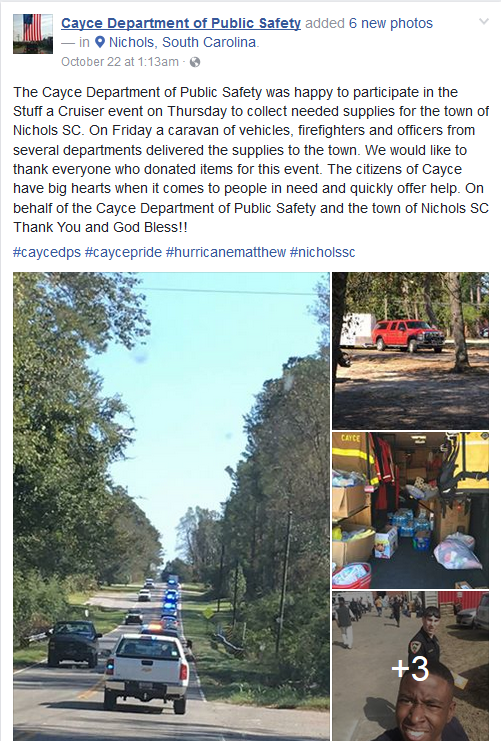
The City of Cayce also lent a helping hand to Nichols by sending public safety officers to help with search and rescue operations immediately after the storm hit.
Then, the Cayce Department of Public Safety and the North Charleston Police Department were two of many local law enforcement agencies that collected goods for people in Nichols.
Just yesterday, House Speaker Jay Lucas of Hartsville took a trip to Nichols to see the devastation first hand. Watch this WIS-TV news report and read this Florence Morning News story to get a snapshot of what Speaker Lucas saw on his visit.

The Speaker recognized a top priority right now is getting the city government back up and running so residents can be assured of police and fire protection. Speaker Lucas also pledged to be the town’s legislative voice to try and identify funding for rebuilding since its local representative has retired.
But that’s what we’re all about in South Carolina….paying it forward and helping out. These are just a few of the stories. Got more? We’d love to know about them.